 ultimate-guide
HVAC System Replacement Cost: 2026 Pricing Guide
Table of Contents
- Average HVAC System Replacement Cost Breakdown
- Factors Affecting HVAC Installation Cost
- Signs You Need a New HVAC System
- HVAC Replacement Financing Options
- Energy Efficient HVAC System Rebates and Tax Credits
- Hidden Costs and Long-Term ROI Considerations
- Frequently Asked Questions
Last Updated: October 7, 2026
Average HVAC System Replacement Cost Breakdown
The hvac system replacement cost varies widely depending on your home's size, the equipment you choose, and your location. At Elisee AC Services LLC, we help families in the Greater Houston area understand what goes into this investment, and the breakdown matters more than any single number.
The total project cost typically comprises the equipment (condenser unit, air handler, and associated components), installation labor, ductwork modifications, refrigerant lines, permits, and any thermostat or electrical upgrades.
Equipment pricing varies by system type and efficiency rating: a basic furnace paired with central air conditioning differs substantially from a high-efficiency heat pump with variable speed blower technology. Labor costs fluctuate by region and contractor experience, and permit fees depend on your local jurisdiction.
Understanding this breakdown helps you decide where to invest: some homeowners prioritize upfront savings, others long-term efficiency and lower utility bills.
Factors Affecting HVAC Installation Cost
Several key variables determine your final hvac replacement cost: system type, equipment size, energy efficiency ratings, regional labor rates, and installation complexity.
System Type and Equipment Size
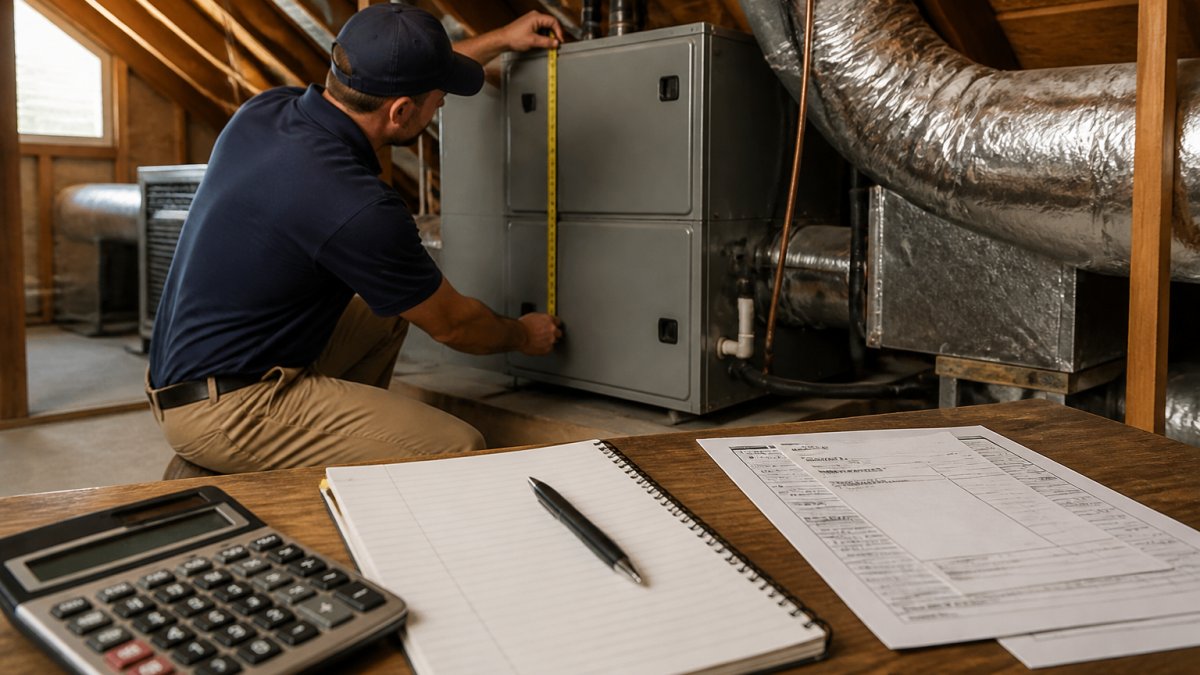
The type of system you choose, a traditional split system, a furnace-based setup, or a modern heat pump, directly impacts your costs. Larger homes require higher-tonnage equipment, which costs more; a 3-ton unit costs less than a 5-ton unit, but undersizing leads to inefficient operation and comfort problems.
Load calculation determines the correct tonnage based on square footage, insulation quality, window count, and local climate. It prevents overpaying for oversized equipment or underpaying for undersized systems, yet many contractors rush this foundational step.
A full system replacement, condenser, air handler, and ductwork modifications, costs more than replacing only the condenser when your existing air handler remains compatible. Retrofitting or upgrading ductwork adds labor hours and materials.
Energy Efficiency Ratings Impact
SEER2 ratings for air conditioning and AFUE ratings for furnaces directly correlate with equipment cost. A system with a SEER2 rating of 18 or higher costs significantly more upfront than a standard 13 SEER2 unit, but delivers measurable energy savings over its lifetime.
Energy Star certified equipment qualifies for rebates and tax credits that offset the higher cost. Variable speed blowers and multi-stage compressors improve efficiency but raise the price, the classic tradeoff between upfront cost and long-term savings.
Installation Labor and Regional Variations
Labor costs vary by region and market. The Greater Houston area, with its hot climate and high cooling demand, sees different rates than cooler regions.
Installation complexity affects labor time: an accessible mechanical room takes fewer hours than a cramped attic or basement retrofit. Electrical upgrades, permit inspections, and duct sealing add to the bill, and emergency peak-season replacements carry premium rates.
Signs You Need a New HVAC System
Knowing when replacement makes sense versus repair saves money and prevents emergency breakdowns during extreme heat.
Age is the primary factor: most HVAC systems last 15-20 years with proper maintenance. Frequent repairs, especially involving refrigerant lines, the compressor, or the air handler, signal declining reliability, and when repair costs exceed 50% of a replacement system's cost, replacement typically makes financial sense.
Rising energy bills despite consistent usage indicate declining efficiency, as an aging system runs longer to compensate. Poor indoor air quality, uneven temperatures, or excessive humidity despite air conditioning suggest your system can no longer handle your home's demands.
Older systems using R-22 refrigerant face increasingly expensive repairs as supplies dwindle and regulations tighten. Upgrading to a modern system with environmentally-friendly refrigerant eliminates this escalating cost.
HVAC Replacement Financing Options
Some utility companies offer rebates or incentives for energy-efficient upgrades, reducing your effective cost. Check with your local utility provider about available programs.
Energy Efficient HVAC System Rebates and Tax Credits
Federal tax credits and manufacturer rebates can meaningfully reduce your net hvac system replacement cost, but only if you know which programs exist, what efficiency thresholds they require, and how to document your claim, the single biggest area where homeowners leave money on the table.
Federal Tax Credits
The Energy Efficient Home Improvement Credit (Section 25C) allows qualifying homeowners to claim a percentage of the installed cost of eligible equipment, up to a certain amount annually for qualifying heat pumps and heat pump water heaters, and for qualifying furnaces, central air conditioners, and air handlers. It is nonrefundable and resets each calendar year, so a project split across two tax years can sometimes capture more of the cap.
To qualify, equipment must meet the Consortium for Energy Efficiency (CEE) highest efficiency tier, generally a SEER2 rating in the mid-to-high teens or above for split-system air conditioners, or 97%+ AFUE for furnaces. Retain the invoice listing manufacturer, model number, and efficiency ratings, plus the Manufacturer's Certification Statement.
Manufacturer and Utility Rebates
Manufacturers run seasonal rebate promotions, often larger in spring and fall when demand softens. Amounts vary by brand and model but stack on top of federal credits in most cases.
Utility rebate programs are administered at the state or local level and vary widely, often paying a per-ton or per-unit rebate for qualifying heat pumps and high-efficiency air conditioners. Because programs change annually and are sometimes capped or exhausted mid-year, search your utility's website for "HVAC rebate" or call customer service before signing a contract. Some utilities also offer financing incentives.
Search the Database of State Incentives for Renewables & Efficiency (DSIRE) for local rebates
How to Sequence Your Claim
- Before signing: Confirm the specific model numbers your contractor proposes appear on the CEE tier list and on your utility's eligible equipment list. A model that qualifies federally may not qualify for a local rebate.
- At installation: Ask the contractor for the AHRI certificate, the Manufacturer's Certification Statement, and an itemized invoice showing equipment cost separate from labor.
- After installation: Submit utility rebate paperwork within the program's window (often 60-90 days). Keep copies of everything for your tax preparer.
What Disqualifies a Claim
- DIY installation of equipment that requires a licensed contractor
- Equipment purchased but installed in a second home or rental property (rules vary by program)
- Missing or mismatched model numbers between the invoice and the installed unit
- Rebate applications filed after the program's deadline or after funds are exhausted
A reputable contractor will hand you the documentation packet without being asked. If yours cannot produce model numbers and efficiency ratings in writing, treat that as a warning sign, and a reason to get a second quote before you commit.
Hidden Costs and Long-Term ROI Considerations
Beyond equipment and labor, several costs catch homeowners by surprise, and the cheapest bid often hides the most of them. Understanding these line items prevents budget overruns and reveals true project cost rather than sticker price.
The Hidden Costs of a "Cheap" Installation
A low bid is not automatically bad, but the pattern behind unusually low quotes is predictable:
- Skipping the Manual J load calculation. A proper load calculation determines the correct tonnage for your home. Contractors who size by square footage alone routinely oversize or undersize equipment, which shortens compressor life, creates humidity problems, and can void the manufacturer's warranty.
- Reusing incompatible components. Pairing a new condenser with an aging air handler or a mismatched coil can drop the system's effective SEER2 rating below the rated value and disqualify you from rebates.
- Skipping the nitrogen purge and deep vacuum. These steps protect the refrigerant circuit from moisture and contaminants. Skipping them is invisible on the invoice but shows up as compressor failure years later.
- No permit pulled. Unpermitted work can complicate a future home sale, void insurance coverage for a related claim, and leave you responsible for bringing the installation up to code.
- Warranty registration not filed. Many manufacturers require registration within a set window (often 60 days) to activate the full labor or parts warranty. A contractor who does not file it leaves you with a shorter default warranty.
Permit and Inspection Fees
Permit and inspection fees vary by jurisdiction, with some municipalities charging by project value and others a flat fee. The permit ensures your installation meets building codes and triggers an inspection, your independent verification the work was done correctly.
Electrical Upgrades
Older homes sometimes have panels or circuits that cannot support a modern high-efficiency system's power draw. A panel upgrade, new dedicated circuit, or disconnect replacement can add to the cost. An inverter-driven heat pump may draw less peak current than the system it replaces, but the circuit still must be sized and protected correctly.
Ductwork Sealing and Insulation
Leaky ductwork wastes a substantial share of conditioned air, industry estimates cite 20-30% loss in poorly sealed systems. Sealing and insulating ducts improves comfort, reduces energy bills, and helps new equipment deliver rated efficiency. Costs depend on accessibility; attic and crawlspace runs typically cost more than basement or garage runs.
Long-Term ROI: When Does High-Efficiency Pay Back?
The premium for a high-efficiency system is recovered through lower monthly energy bills. Break-even depends on three variables: the efficiency gap between standard and premium units, your local utility rates, and your climate's cooling or heating hours.
A practical way to estimate it:
- Ask each contractor for the estimated annual energy use of the standard and premium options (many provide this on the AHRI certificate or via manufacturer software).
- Multiply the kWh or therms difference by your utility's rate.
- Divide the upfront price premium by that annual savings figure.
The result is your rough break-even in years. In hot climates with high cooling loads, high-efficiency systems pay back faster than in mild climates. Reliability improvements, fewer repairs and emergency calls, longer equipment life, add to the return but are harder to quantify.
At Elisee AC Services LLC, we help homeowners evaluate complete ROI, including energy savings, improved comfort, and reduced maintenance headaches. Our licensed technicians assess what your home needs and what you can realistically expect to save.
Frequently Asked Questions
How much does a typical residential HVAC system replacement cost?
Total residential HVAC system replacement cost ranges widely based on system type, equipment size, and labor. A central air conditioning unit, forced air furnace, or heat pump installation typically costs more than replacing individual components. Equipment pricing depends on SEER2 and AFUE efficiency ratings, while installation labor varies by region and complexity. Request a quote from a licensed HVAC contractor for accurate pricing specific to your home's square footage and existing ductwork.
What factors affect the total cost of HVAC replacement?
Key factors include system type (AC-only, furnace, or full system), HVAC tonnage and sizing based on load calculation, equipment efficiency ratings (SEER2 for cooling, AFUE for heating), ductwork modifications needed, refrigerant line installation, thermostat upgrade, permit fees, and regional labor costs. Homes requiring ductwork replacement or retrofitting for system compatibility pay significantly more than straightforward installations in existing systems.
Are there tax credits or rebates available for energy-efficient HVAC systems?
Federal tax credits apply to qualifying Energy Star certified HVAC systems that meet specific SEER2 and AFUE thresholds. Many states and local utilities offer manufacturer rebates and incentive programs for high-efficiency equipment. Contact your utility company and review IRS guidelines for current year eligibility. A licensed HVAC contractor can help identify which systems qualify.
How long should a residential HVAC system last before replacement?
Most HVAC systems have a lifecycle of 15-20 years with proper preventative maintenance. Older systems using R-22 refrigerant or showing signs of frequent breakdowns may warrant replacement sooner. Emergency replacement during extreme heatwaves costs more than planned upgrades. Scheduling replacement during off-season months can reduce labor costs and ensure better availability from licensed technicians.